
Trust and accountability in an era of autonomous systems
Cloud and SaaS providers are increasingly deploying agentic AI – systems capable of acting with a degree of autonomy, including initiating actions or influencing decisions with limited human intervention. These technologies are accelerating cross-border data flows and increasing the complexity of modern data processing environments, particularly where personal information is handled across distributed cloud infrastructures.
As automation increases, organizations that process personal data on behalf of others face heightened expectations to demonstrate effective governance, safeguards, and accountability in practice. Recent analysis of the Global Cross Border Privacy Rules (CBPR) framework highlights how emerging technologies are placing additional pressure on traditional approaches to privacy governance, especially in cross-border contexts (see, for example, analysis by by Hogan Lovells). A piece in Cybersecurity Law Report also draws connections to the importance of CBPR and PRP to measuring and optimizing data security and cyber security, as the PRP system is a stepping stone to more complex security standards like ISO and SOC 2.
In this context, the Global Privacy Recognition for Processors (PRP) certification is increasingly relevant for cloud and SaaS providers seeking a structured way to evidence accountable processing.

(Image by Divya Sridhar.)
What the Global CBPR and PRP systems are (and why the distinction matters)
The Global Cross Border Privacy Rules (CBPR) System, administered by the Global CBPR Forum, is a voluntary, accountability-based certification framework designed to facilitate trusted cross-border transfers of personal information while promoting strong and interoperable privacy protections across different regulatory approaches. The system builds on the former APEC (Asia-Pacific Economic Cooperation) CBPR framework and extends its reach globally through new, participating and associate member country and jurisdiction participation.
Within this framework, certifications are aligned to organizational roles:
- Global CBPR certification applies to organizations acting as data controllers, entities that determine the purposes and means of processing personal information.
- Global PRP certification applies to organizations acting as data processors, such as cloud service providers and SaaS platforms that process personal information on behalf of controllers.
As described by the Global CBPR Forum, PRP certification is intended to help processors demonstrate that their internal policies, controls, and operational practices support controllers’ privacy obligations, including when data is processed or transferred across borders. Certification is achieved through assessment by approved third-party Accountability Agents, which evaluate an organization’s practices against established program requirements and support ongoing compliance expectations.

(Image by Divya Sridhar.)
Why agentic AI increases processor-side responsibility
Agentic AI can amplify privacy and governance challenges for processors because these systems often operate continuously and extensively, rely on interconnected components such as models, tools, and data stores, and may span multiple environments or jurisdictions. These characteristics can make it more difficult to demonstrate consistent accountability, maintain effective oversight, and ensure that processing remains aligned with defined purposes, especially where actions are automated or only partially human-supervised.
At the same time, the entire data ecosystem – customers, business partners, vendors, sub-processors and regulators – increasingly expect processors to show that privacy safeguards and governance structures are durable and auditable, even as AI-driven processing becomes more dynamic. In this environment, processor-side controls play a critical role in maintaining trust in cross-border data processing arrangements.
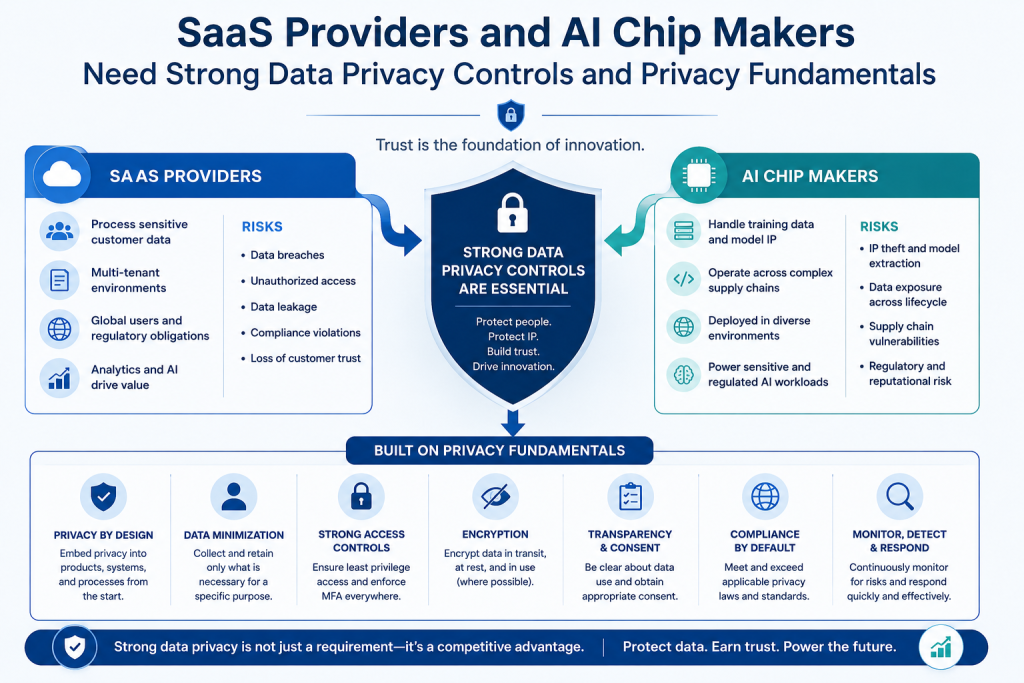
(Graphic by Divya Sridhar.)
How PRP certification can help cloud and SaaS providers demonstrate trust
For cloud and SaaS providers operating as processors, PRP certification is designed to help demonstrate accountable processing practices and to assist controllers in identifying qualified processors. In AI-enabled processing environments, PRP certification can provide several important signals:
- Demonstrated processor accountability
PRP certification focuses on a processor’s ability to implement privacy practices that support controllers’ obligations under applicable data protection frameworks. Under the PRP System, a participating data processor must meet 18 baseline program requirements, including eight security safeguards and 10 accountability safeguards to show that it has appropriate controls in place to help data controllers meet their obligations under the CBPR program requirements.
- Independent assessment and verification
Organizations seeking PRP certification undergo review by Accountability Agents recognized within the Global CBPR system, providing third-party verification of privacy practices. This review can only be conducted by approved Accountability
- Cross-border readiness
The Global CBPR and PRP certifications are intended to support trusted cross-border processing and transfers of personal information under an accountability-based framework that includes soft law mechanisms, where the privacy enforcement authority can probe further into the practices of the participating organizations, or support investigations with privacy enforcement authorities across other jurisdictions in a joint effort to review data privacy and security practices subject to the CBPR and PRP.
- A governance posture that can scale with evolving technology
The Global CBPR and PRP framework emphasizes interoperability and practical governance, positioning it to remain relevant as technologies and data practices continue to evolve, including when the use of tech is autonomous (e.g., when processors use agentic AI).
Practical takeaway: treat PRP as part of broader AI governance
In practical terms, organizations considering PRP certification should view it as part of a broader governance strategy rather than as a standalone compliance exercise. For cloud and SaaS providers deploying agentic AI, this includes clearly defining processor responsibilities, maintaining documented controls that align with controller requirements, and ensuring those controls remain effective as systems evolve. In this way, PRP certification can help bridge the gap between rapidly advancing AI capabilities and the trust-based expectations that underpin cross-border data protection frameworks.

(Image by Divya Sridhar.)
The Centre for Information Policy Leadership (CIPL) published a report in March 2026 analyzing the overlaps between the CBPR and PRP framework and the EU General Data Protection Regulation (GDPR). The report states that the CBPR and GDPR are 72% aligned, while the PRP framework is more than 75% aligned to GDPR. Companies that want to be grounded in a flexible but interoperable modern regulatory framework can rely on the PRP as a relevant and credible framework in the current, complex regulatory environment.
Privacy as an enabler of responsible AI
As agentic AI becomes more deeply embedded in cloud services, privacy is no longer simply a compliance requirement; it is a foundation for digital trust and sustainable cross-border operations. The Global PRP certification offers processors a practical, internationally recognized mechanism to demonstrate accountable processing practices, particularly valuable in environments where AI-driven systems increase complexity, autonomy, and cross-border data movement.
About the author

Dr. Divya Sridhar is the Vice President, Global Privacy Initiatives & Operations at BBB National Programs. She is a seasoned leader focused on data privacy and emerging technology policies, and has served in numerous capacities at think tanks, private companies, and nonprofits leading government affairs and policy work. She has written books and authored publications in the fields of tech, privacy, and public policy.